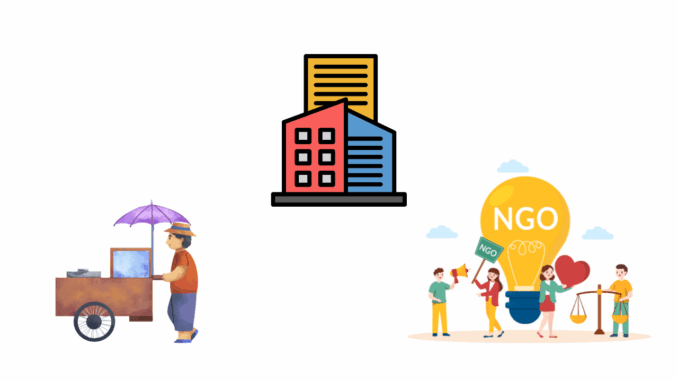
One of the first questions every entrepreneur asks is, “What type of business should I register?”
And honestly this decision shapes almost everything that follows, your tax position, your personal risk, your ability to grow and even how seriously people take your business.
Yet many entrepreneurs rush this step, they register whatever sounds easiest or cheapest, only to realize much later that they chose the wrong structure, by then changing it can be costly, stressful, and disruptive, so let’s slow things down and talk about this properly.
In South Africa the three most common business entities are the Sole Proprietor, the Private Company (Pty) Ltd and the Non-Profit Organisation (NPO). Each one has its place and each one can either help or hurt your business depending on your goals.
A sole proprietor is the simplest form of business there is no separate legal entity you and the business are the same person, this is where most hustles start. You trade under your own name or a trading name, income flows directly into your personal bank account, and everything is declared under your personal tax return.
People choose this structure because it’s easy to start, requires no registration with Companies and Intellectual Property Commission, involves low administration, and is relatively cheap. It’s common for freelancers, consultants, content creators, small traders, and side hustles.
The biggest risk most people ignore is that there is no protection at all, If the business owes money, you owe money, If something goes wrong, your personal assets are at risk, your personal bank account can be attached and SARS treats all income as your personal income. This may be manageable when income is small but it becomes dangerous as the business grows, you are also taxed at personal tax rates, which increase as your income increases with no separation between business and personal tax.
A sole proprietorship makes sense when you’re testing an idea, earning irregular income, just starting out, operating with low risk, and not planning to scale yet. For most entrepreneurs, however, it’s a temporary structure rather than a long-term solution.
A Private Company, or (Pty) Ltd, is the most popular structure for growing businesses in South Africa, this is where your business becomes its own legal person, completely separate from you. The company is registered with CIPC, has its own registration number, its own tax number, its own bank account, and is managed by directors and shareholders in simple terms, the business is the business and you are you.
Entrepreneurs choose a (Pty) Ltd because it offers limited liability, looks professional, makes it easier to access funding and tenders, supports scaling, and creates a clean separation between personal and business finances. It is common for growing SMEs, construction companies, transport businesses, agencies, retail operations, and online brands that plan to scale.
One of the most misunderstood benefits of a (Pty) Ltd is protection if the company fails, the company owes the money not you personally, unless you have signed personal surety. For many entrepreneurs that protection alone makes this structure worth it, from a tax perspective, companies are taxed at a fixed rate rather than progressive personal rates, making tax planning easier, expenses are clearer, and directors still declare salaries or dividends personally, which gives more control over how tax is managed.
That said a Private limited does come with responsibilities, there are annual returns, beneficial ownership filings, company tax returns, bookkeeping, and ongoing compliance but the reality is simple, structure costs money, while chaos costs more. A Private limited makes sense when you want to grow, protect yourself, build credibility, access funding or tenders, maintain clean separation, and build something long-term for many entrepreneurs, this becomes the right move once income is consistent.
An NPO, or Non-Profit Organization, is often misunderstood many people hear “non-profit” and assume it means no money can be made that’s not true, an NPO can generate income, but it cannot distribute profits to individuals any surplus must be reinvested into the organization’s purpose.
NPOs are registered with CIPC and the Department of Social Development, operate for a public or community benefit, and are governed by a constitution they are common for NGOs, community projects, foundations, churches, educational initiatives, and social upliftment programmes. The most important rule is that money cannot be paid out as profit to founders from a tax perspective, NPOs can apply for tax exemptions but must still submit returns and meet strict reporting requirements, misuse of funds can lead to serious penalties.
An NPO makes sense if your goal is social impact, donor funding, and community benefit, and if profit distribution is not your objective and if your goal is personal income or commercial growth, an NPO is not the right structure.
So which structure should you choose? The honest answer is that it depends on your income level, risk exposure, growth plans, and long-term vision. A sole proprietor is easy and cheap but risky and best suited to the early stages. A (Pty) Ltd is professional, protected, structured, and scalable, making it ideal for growth. NPO is purpose-driven, regulated, and designed for impact work rather than profit.
The biggest mistake many entrepreneurs make is choosing a structure based only on what’s cheapest today instead of what will protect them tomorrow, many start as sole proprietors, grow quickly, make serious money, then get hit with tax, liability, or legal issues and panic, an organized entrepreneur plans ahead.
Your business structure is not just paperwork it’s a strategy it affects your money, your risk, your stress levels, your growth, and your future. Choose the structure that matches where you’re going, not just where you are today, when your foundation is right, everything else becomes easier.
Leave a Reply