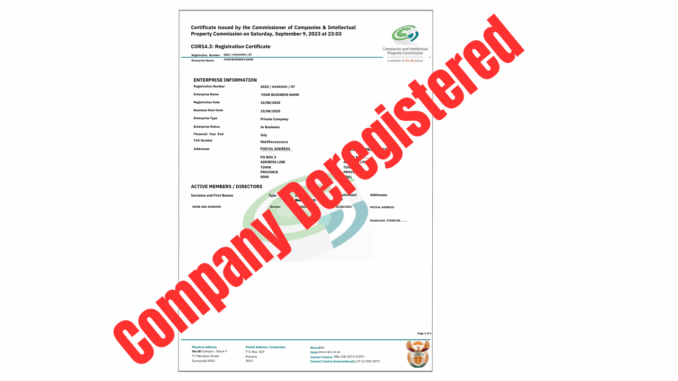
Few things hit harder than finding out your company has been deregistered. One day you’re running your business as usual, and the next day the bank tells you your account is frozen, or a client informs you that your company “doesn’t exist on CIPC anymore.” Panic sets in fast.
If this has happened to you, pause and take a breath, you’re not alone and in most cases, this problem can be fixed. Let’s talk through what deregistration really means, why it happens, and what you should do next.
When a company is deregistered by the Companies and Intellectual Property Commission, it means that legally, the company is no longer recognised as existing and paper, it’s as if the company has been switched off. This affects everything, your business bank account, contracts, tenders, funding applications, tax matters, and compliance documents. Banks, SARS, and other institutions rely on CIPC data, so when CIPC shows your company as inactive or deregistered, everyone else follows.
The most common reason companies are deregistered in South Africa by far is failure to submit CIPC annual returns. It usually happens quietly over time. In the first year the annual return is missed, in the second year, it’s missed again by the third year, CIPC flags the company for deregistration, and shortly after, the company is deregistered. Many business owners don’t even realize this process is underway because emails go to old addresses, contact details are outdated, or they assume that no news means everything is fine. Unfortunately, silence from CIPC is not safety.
While annual returns are the biggest cause, other reasons for deregistration can include company inactivity, voluntary deregistration requested by directors, failure to submit Beneficial Ownership information, or incorrect and outdated company details. Still missed annual returns remain the main culprit in most cases.
You can confirm whether your company is deregistered by doing a free company search on the CIPC website or a trusted company search platform. You may see statuses such as “In Business,” “AR Overdue,” “In Deregistration,” or “Deregistered.” If your status shows “In Deregistration,” you should act immediately. If it already shows “Deregistered,” don’t panic but do act quickly.
The real life impact of deregistration is serious, a deregistered company cannot legally trade, invoice clients, apply for funding or tenders, or enter into certain contracts. Bank accounts may be frozen or closed, and existing agreements may be questioned. SARS compliance also becomes more complicated, and in some situations, directors may be personally exposed to liabilities that would normally sit with the company. Many entrepreneurs only discover deregistration when a payment fails, a transaction is rejected, or a client asks for documents which is why it feels sudden, even though the problem built up over years.
The big question most people ask is whether a deregistered company can be fixed. In most cases, the answer is yes. If the company was deregistered due to non-submission of annual returns, it can usually be reinstated. Reinstatement brings the company back to life, both legally and operationally, but it must be done correctly.
The reinstatement process starts with confirming the reason for deregistration, this determines what documents and steps are required. Most reinstatements involve outstanding annual returns you will then need to file all missed annual returns for every outstanding year, including Beneficial Ownership filings, which are now mandatory. CIPC will not reinstate a company with gaps in these submissions.
Once the returns are filed all related penalties and fees must be paid, late submissions attract penalties, and the longer the delay, the higher the cost. Trying to avoid or delay payment usually slows the reinstatement process, after everything is filed and paid, a reinstatement application is submitted. CIPC reviews the application, and in many cases, reinstatement can be processed within days rather than months.
Once the company is reinstated, its status changes back to “In Business.” You can then approach your bank to unfreeze accounts, and normal business operations can resume.
Many entrepreneurs ask whether it’s better to reinstate the old company or simply open a new one. Reinstating the old company is usually the better option if it has a trading history, an existing bank account, active or past contracts, SARS registrations, or a company name with value. It’s important to remember that deregistration does not cancel tax obligations. SARS obligations follow the entity, not the status.
Opening a new company may make sense if the old company never traded, has no bank account or contracts, no tax issues, and you genuinely want a clean operational reset even then, old compliance issues do not automatically disappear, and SARS may still expect outstanding returns to be submitted where required.
A common and dangerous myth is the belief that deregistration means you no longer owe SARS anything. This is false. Deregistration with CIPC does not cancel outstanding tax returns, penalties, interest, VAT, or PAYE obligations. CIPC and SARS are separate systems, and SARS has a long memory.
Avoiding deregistration in the future is not complicated it requires consistency. Organized entrepreneurs save their company anniversary dates, file annual returns every year (even when the company is dormant), keep Beneficial Ownership details updated, use compliance reminders, and never ignore emails from CIPC or SARS, when unsure, they get professional help early. Staying compliant is far cheaper than fixing non-compliance.
If your company has been deregistered, don’t beat yourself up this happens to thousands of South African businesses every year, including smart and hardworking entrepreneurs. What matters is what you do next, deregistration is not the end of your business journey, but it is a wake-up call. Get organized, fix what needs fixing, and put systems in place. That’s how hustles turn into sustainable businesses and that’s what the Organized Entrepreneur mindset is all about.
Leave a Reply