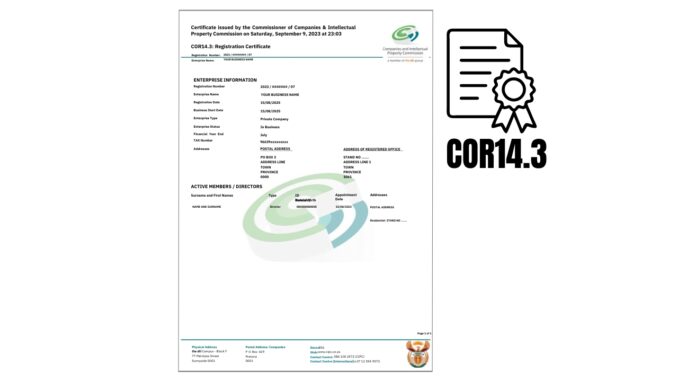
If you’ve ever registered a company in South Africa, you’ve probably received a bundle of documents from CIPC with names like COR14.3, COR15.1A, and others that look like they belong in a law textbook. Most entrepreneurs react in one of two ways, they save the documents somewhere and never look at them again, or they lose them completely and panic when someone suddenly asks for them.
That panic usually starts when a bank, funder, supplier, or government department says, “Please send us your CIPC documents.” Suddenly, what felt like boring paperwork becomes urgent and stressful. This is why it’s important to slow things down and understand what these documents actually are, why they matter, and when you’ll need them.
Your CIPC documents are not just registration papers, they are the identity documents of your company. Just like you can’t open a bank account or apply for a job without an ID, your company cannot open a bank account, apply for funding, register for VAT, register on CSD, apply for tenders, or sign certain contracts without the correct CIPC documents. If those documents are missing, outdated, or incorrect, your business simply gets stuck.
The most important document every business owner should know is the COR14.3, this document confirms that your company exists it includes the company name, registration number, date of registration, company type such as a (Pty) Ltd or NPC, and the names and ID numbers of directors. When someone asks you to prove that your company is registered, this is the document they are asking for. You will need it for banking, SARS registration, VAT registration, CSD registration, tenders, and funding applications if your company is still active, it can always be re-downloaded from the Companies and Intellectual Property Commission system.
Another key document is the COR15.1A also known as the Memorandum of Incorporation (MOI), in simple terms this document is the rule book of your company. It explains how directors are appointed or removed, how decisions are made, how shares work, and what powers the company has. Most small businesses use the standard MOI provided by CIPC, which is why many entrepreneurs don’t remember dealing with it however, the moment you want to add shareholders, change ownership percentages, bring in investors, or alter how the company is governed, the MOI becomes extremely important. Banks and investors often ask for it.
Share certificates are another document many entrepreneurs overlook. These certificates show who owns the company and in what percentage even if you are the only director and shareholder, your company should still issue a share certificate in your name. Share certificates become critical when there is more than one shareholder, when you want to sell part of the business, bring in a partner, or apply for funding or investment. Many small businesses forget to issue them, which leads to ownership disputes and delays later.
One of the most important and most ignored requirements today is the Beneficial Ownership (BO) declaration. CIPC now requires companies to declare who actually owns and controls the business, this information must be submitted every year and whenever ownership changes. Without a valid BO declaration, you cannot submit your annual return, your company becomes non-compliant, banks may flag your profile, and funding applications may be rejected. This requirement is no longer optional — it is mandatory.
Each year when you submit your CIPC annual return successfully you receive a confirmation document, often referred to as CoR30.1 this document proves that your company is active and that your annual returns are up to date. It is commonly requested during tender applications, funding applications, CSD registrations, and compliance renewals. If your annual returns are overdue, you won’t have this confirmation, and that immediately raises red flags.
Director information must also always be accurate whenever a director is added, removed, or has their details changed, CIPC requires proper supporting documents. If these updates are not done correctly, your records become outdated, banks may reject your documents, SARS registrations can be delayed, and compliance checks can fail. What’s on the CIPC system must always reflect reality.
Having the correct CIPC documents doesn’t just protect the business it protects you personally as a director. Missing or incorrect documents can lead to personal liability, challenged contracts, ownership disputes, and banks refusing to assist you. Organised entrepreneurs don’t wait for problems to arise, they keep their documents clean and up to date.
Common mistakes happen often, entrepreneurs lose their COR14.3, never issue share certificates, ignore beneficial ownership filings, forget annual returns, use outdated director details, or assume that deregistration automatically cancels SARS obligations. These mistakes are expensive, stressful, and completely avoidable.
Staying organized doesn’t require complicated systems, a simple approach works best. Create a digital compliance folder and store your COR14.3, MOI, share certificates, beneficial ownership confirmations, and annual return confirmations in one place. Review these documents at least once a year and update CIPC whenever changes happen. This single habit can save you years of stress.
CIPC documents may look boring but they are powerful, they determine whether your business legally exists, whether you can trade, whether you can access funding, and whether your bank account stays open. An organized entrepreneur doesn’t ignore paperwork they understand it and when your documents are in order, your business moves faster, smoother, and with confidence.
Leave a Reply